The Studio
Up to date pictures of the studio: (Sticky)
Probably about time for an update? BIG changes in the studio! (16/2/2010)
Hard to believe 4 years have passed since my last update! But this is a big one, major changes in the studio.

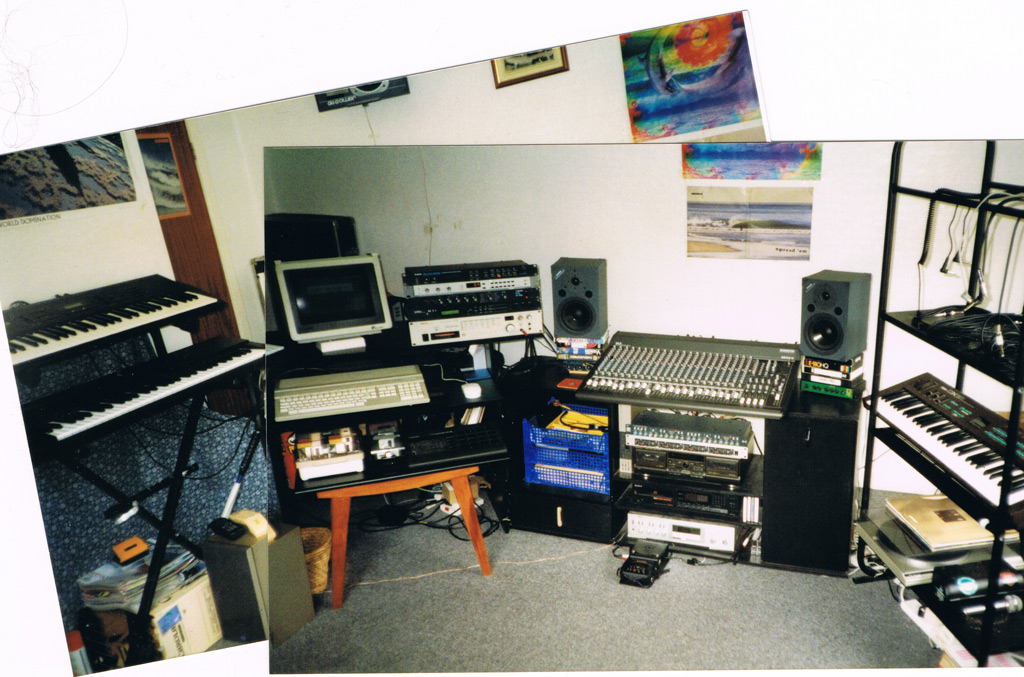
Once upon a time, I bought a Yamaha YMC-something one track midi sequencer to record short keyboard or drum parts to play over, no quantize, no editing, nothing but record and playback. Most analogue sequencers from the 70's had more functionality than this! Though it did see some use along with my Yamaha MT-120 4-track tape recorder! My main keyboard at the time was my first keyboard; a Yamaha PSR-6! Along side these was my Acorn Electron computer for blips and bleeps! The good thing is that I have no recordings from this era to laugh at!

A lot has changed in the 20 odd years I've been making music and it's very easy to become stuck in your ways; to become an 'old git' who shrugs off any new innovations as 'modern rubbish' regardless what it may be. I've been a dedicated Steinberg user since their very first professional sequencer packages on Atari and for good reason; being that they specialised in midi hardware sequencing and provided full control from the very beginning (Cubase 3 was very powerful indeed). I was late making the move to PC (2005!) and only then started using Cubase SX (missing Cubase VST), which was great for a time but I was finding software mixing/engineering very different and together with the limitations of my out-dated computer just wasn't cutting it.

A couple of years ago I got some tabla lessons from local percussion wizard Jon Sterckx, he has been working with various live-loop-sampling equipment for years but had recently moved into Ableton Live for this feature. After a few sessions with his looping, and sessions here with my analogue synths; we decided to try working together on some live material mixing the two - this began my journey into Ableton Live.
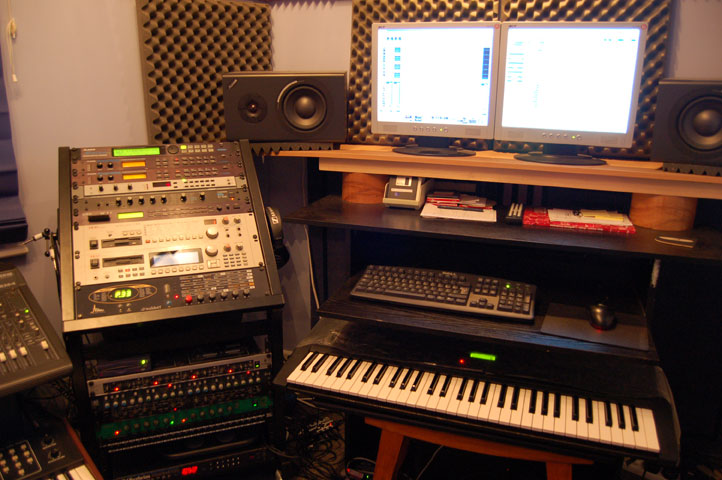
Since experimenting with Live I've found that it is a very creative way of working. Together with my fairly modern laptop; it allows endless chaining of software effects like EQs and compressors without worrying about CPU at all, enabling me to shape and control sound like never before. Also Ableton's interface with the live or arrangment views are very good for quick creativity and very quick application of external controllers etc. It has also taken over my mixing desk since all the synths are going directly into the soundcard, many advantages to this. So, musical life is fun again...

One more large shift in my methods is regarding digital synths, it's a fact that software is not able to faithfully replicate the sound of analogue synths, but I've always anticipated that a computer should be able to do the same job as any digital synth. After much testing and comparing I have come to the conclusion that a software synth like the FM7 is actually a better tool than it's original inspiration; the mighty DX7. The sound of the preset 'Glassy Elec Piano' is slightly thicker on the real DX7 but I'd often EQ it down to the same sound the FM7 gives so that it sits in the mix correctly anyway. Then add the intuitive graphical interface of the FM7 verses the push-button menus of the DX7, plus the additional routing and functionality of the FM7, the conclusion was - sell the DX7. I'm also really liking the software Korg Wavestation which sounds just as good as the original if not better. So digital synths are no longer required.
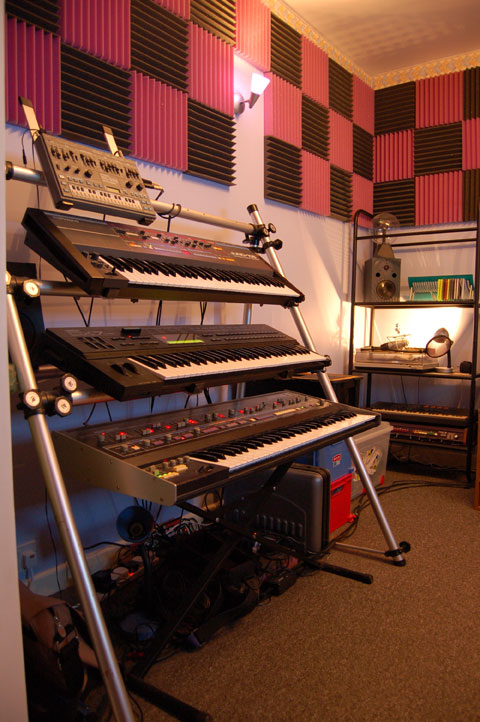
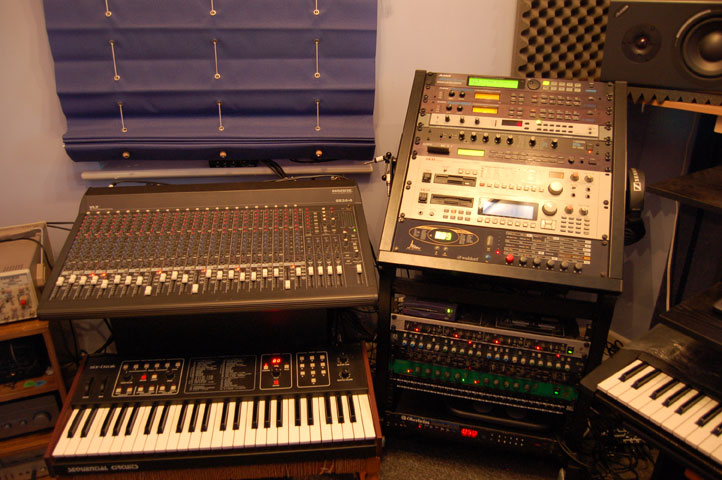
With this in mind, I've completely rewired the studio; audio and midi, so the laptop becomes the centre of attention. I'm selling all my digital synths so my synth stand becomes analogue only, most of digital effects units will be sold and the rack space reserved for future projects such as a Doepfer/AS modular?!?! I'll report back again soon.
Simmons SDS9 - PDF user manual available for download (15/1/2007)
My friend Keith has had his Simmons SDS9 for ages but we had never fully worked out the midi functions due to not having a complete manual. Now, thanks to a member of the vintage-synth forums, we have a complete english version of the full user manual and I've put it on here for anyone to download: Simmons SDS9 manual.
Cubase 4 & Midi Device Panels (26/11/2006)
I've upgraded to Cubase 4 but its not all good news at the moment. Most of my works-in-progress from SX3 loose effects settings when opened in C4, this is because of a bug that has been recognised by Steinberg on the forums. This means it's either a repair job to try and get the sounds back to how they were, or install SX3 as well and open projects in both versions to copy the settings across manually. This is a major issue to me and hopefully will be put right in a coming update. Read more on the www.cubase.net forums.
Other than that Cubase 4 seams stable and I'm happily making new tunes. There are quite a few additions that make life easier with regard to the channel strips, with inserts you can now copy and paste effects either to change the order or across to other channels as well. You can copy and paste entire channel strips about with all settings intact and even save them as presets for recall later. C4 handles VSTi with multiple outputs better by only activating the channels you are using; you choose how many are active and therefore how many show in the mixer. There are a lot more changes but not all of which are things I would use.
The best new toy I have though is my own creation; a device panel for the Six-Trak :) Inspired by a mixermap for this synth I had realised it was possible to get the parameters (knobs/sliders etc) to move when automated and also when you recall a patch. This doesn't happen with the other device panels I have from Cykong that are sys-ex based, and I'm guessing that Cubase can only respond to controller numbers at the moment or something. I'm hoping Steinberg will continue developing these panels in the coming updates, you can read more on the cubase.net forums though there isn't as much interest as I would like to see really. I've also been trying to get some conversation about device panels on the vintagesynth.org forums.
eBay gets the better of me again... (28/4/2006)
I'll never be a rich man. I now watch eBay regularly for vintage synths and any other interesting musical gear. Though most of the time the famous equipment sells for a lot of money there are still bargains to be had for those who keep their eyes open. I've watched many items over the last few weeks but patience is very important and it has paid off. The Oberheim Matrix 1000 rack synth is a very common sight on eBay and I've been watching for a bargain for some time. Usually these go for under £200 which is just a little crazy considering there is a huge 12 oscillator analogue synth inside that 1u rack. Sometimes an auction will go unseen, in this case because of missing keywords; the seller called this a 'sound module' and missed out using the words 'synth' or 'synthesizer', I found it by searching for 'oberheim matrix'. As a result I was the only person to bid and got it for £140 including the postage!
The Matrix 1000 isn't really a 'vintage' synth as they were released in 1987 and were still being made in 1994, so that makes it one of the last true analogue synths of this kind being produced for the mass market. It was designed as a simple to use sound module containing 1000 of the finest sounds created on the Matrix 6 keyboard, they are exactly the same synth but the rack version can only be edited via midi sys-ex. This will off-course be one of the first things I try to do and will post my findings on here when I get this beast sometime next week.
(Update 23/7/2006: See the Matrix 1000 page)
New toy: Roland HandyPad (Pad-5) (20/4/2006)

A very spontaneous purchase, I picked up a Roland Pad-5 midi controller which I didn't know existed before seeing it listed on eBay. It's half way between a toy pad, such as the Yamaha DD series, and a more professional pad like the Octapad style. Although it states you can use drum sticks on it, in my opinion the pads are far too small for this purpose. This controller is for fingers and thumbs like a tabla/conga style interface and a very good one! It responds well to pressure making it very expressive on a huge range of sounds from velocity-switching drum sounds and synths to any samples you fancy playing, adding an alternative to keyboard input. A multi-sampled tabla set is now well on my list of things to get! It is called the handy pad and that is definitely the best way to describe it. By request I have ripped and uploaded the useful bits of the user manual for download here.
New synth: Casio CZ1000 (3rd May 2006)
About time for a new addition to the studio, I spotted a Casio CZ1000 in the paper going cheep so I've added that to my kitlist. I had borrowed a CZ-101 years ago and loved it, its been sampled and used in a few of my older tunes. The CZ1000 is basically a CZ-101 with full size keys, if I see a 101 going cheep somewhere I may grab it, the smaller the better really as I don't need a room full of 5 octave synths, or rather I have no room!
Partially fixed kit... (25th June 2005)
Well I've managed to get the Juno-106 working fine over midi now by replacing two of the broken voice chips. However there are still two inactive voices when the synth is played from its own keyboard. Its a tricky job and to be honest I've kinda messed it up by using a soldering iron with a knackered tip. Still we have progress!
The SY-55 keyboard problem was super easy to fix. You need to remove a lot of screws and the main covering to the keyboard area inside the synth, there is a rubber strip beneath the keys which runs the full length of the keyboard and this had an obvious mark where the dodgy key was. I phoned Yamaha support who instantly knew what part I was after and supplied it for £11 delivered! It took about 5 minutes to fit and the keyboard is now as good as new :)
Fixing kit... (31st May 2005)
At the moment I am sorting out all my gear with tech problems. The biggest job is the Juno-106 and replacing two broken voice chips. Also the SY-55 and its dodgy key needs to be fixed before i can sell it, surplus to requirements. Got my eye on a few new bits of kit ;)
Have both ends of the room tiled now, still need about 10 large tiles for the roof then that's all done..
My faithful Atari finally goes into retirement... (28th March 2005)
Ongoing work to the studio has led to a serious change! My faithful Atari has left the studio for the first time in 12 years. For as long as I can remember the Atari 1024stfm has run the show. Firstly on Steinberg's Pro Twelve midi sequencing software, then up to Cubase v3 which has kept me going all these years. Now finally the studio and the PC have embraced each other in sweet harmony with Cubase SX running all my midi gear seamlessly plus full multitracking.
I also have the 40 acoustic tiles up now; looking and sounding brilliant, very happy, just need a box for the other end of the room now! There will be pictures up soon. If you are interested in acoustic tiles search for "acoustifoam" on ebay.
Comments (20th March 2005)
Getting 40 acoustic tiles tomorrow! :) If you are interested look for "acoustifoam" on ebay.
New monitors, acoustic tiles, Casiotone 202 (6th November 2004)
Received my new monitors (Alesis Monitor One's) and 6 acoustic tiles this week so big changes in the studio. Also bought a Casiotone 202 out the paper for £45, 1981 digital keyboard which I believe is the second synth Casio ever released. It has a really nice Harp sound that will be used very soon, no control though so it will have to be multi-sampled or something. (This keyboard is now for sale; £45 ono)
Living in a box (26th October 2004)
Well, despite having the new studio room I aint made a tune in many months! When I drop a tune it sounds fine, but when I burn it to CD and take it out to hear in different locations it always sounds terrible! How frustrating. However I have worked out what the problem is; its the acoustics in the room. Being nearly a perfect cube its a great resonant reverb chamber. Need to spend some money treating the room.
The studio is assembled in its new environment. (Summer 2003)

The first jam..............6.6.2003................................^
The new studio was officially broken in with help from the Coleman brothers. Mark's metal guitar frenzy and Paul's rolling drum machine mayhem occasionally joined by my nasty synth bass's made for a good test of the sound proofing! Totally inspiring and more did follow...
The studio was under construction. (Winter / Spring 2003)
After living, sleeping, working and playing in my 1 bedroom for nearly my whole life; at last in 2003 I got two rooms. Finally I could have a dedicated studio room. The room wasn't designed with acoustics or electrics in mind so it actually ended up the wrong shape for a studio really.

Carl Benson and his team did a great job building the extension as you can see above. Only half of it is mine; the other half (seen only in the third picture) is an extra room on the side of the lounge.
Keyboards / Synthesizers
- Casio CZ1000
- Kawai K1r
- Oberheim Matrix 1000
- Roland Jupiter 6
- Roland Juno 106
- Roland MC-202
- SCI Sixtrak
- Waldorf Pulse
- Yamaha DX7
- Yamaha SY-55
Drum Machines
Sequencing / Mixing
- Alesis Monitor One
- Alesis Point Seven
- Alesis 3630 Comp/Gate
- Behringer 4xGate
- LA Audio 4x4 Comp/Gate
- Mackie SR 24:4
- Steinberg Cubase 4
Samplers / Multitrack
- Akai S3000xl
- Akai S01
- Fostex MR-8
Effects Units
- Alesis Midiverb 4
- Alesis Quadraverb (x2)
- Alesis Microverb II
- Peavey DSR1000
- Boss RV1000
Other Stuff
- Samson Condensor Mic
- AKG Dynamic Mic
- Dean Bass Guitar
- Yamaha Pacifica 6 string
- Roland HandyPad
- Assorted Percussion
- For information on my musical history see: Musical Background
- To listen to some of my music: Music / Audio Files